

How to Plan a Budget Beach Vacation That Actually Delivers
There’s something about the ocean that resets everything. The sound of waves, the feeling of warm sand underfoot, the way sunlight looks different when it’s bouncing off water — none of these experiences belong to a specific income bracket. A beach vacation on a budget is genuinely possible, and not in a “make do with less” way. With the right timing, some smart pre-trip decisions, and a willingness to spend money where it actually matters, you can have a trip that feels every bit as good as one that cost twice the price.
The idea that beach vacations are inherently expensive has kept too many women from booking the trips they want. This guide is here to dismantle that — practically, honestly, and without asking you to give up the parts that make a beach trip worth taking.
Timing Is the Most Powerful Budget Tool You Have
The price of an identical hotel room at an identical beach destination can swing by 40 to 60 percent depending simply on when you book it. This isn’t a secret or a loophole — it’s how travel pricing works, and once you understand the patterns, you can use them deliberately.
Shoulder season is consistently the best value. For most coastal destinations in North America, Europe, and Southeast Asia, the sweet spot sits in late May to mid-June, or September into early October. The weather is often excellent — sometimes better than peak August, when crowds make even the nicest beaches feel exhausting and overpriced. Prices for accommodation, flights, and even restaurant meals drop meaningfully the moment school summer holidays end.
Midweek travel compounds the savings further. A Thursday check-in versus a Friday check-in can reduce your accommodation cost by 20 to 30 percent on many booking platforms. If your schedule has any flexibility, that flexibility translates directly into money. Combine shoulder season timing with midweek arrival and you’re already looking at a meaningfully different budget before you make a single other decision.

On the question of booking early versus booking late: for shoulder season trips to less-touristed destinations, last-minute deals are real. Properties that aren’t close to full often discount aggressively in the final two weeks before arrival. For anything near a public holiday or school break, early booking — three to six months out — locks in better rates before demand spikes. Knowing which category your trip falls into is worth a few minutes of research before you start comparing prices.
Where You Stay Changes the Entire Budget
Accommodation is usually the single largest line item on any trip, and it’s also where creative thinking pays off the most. The question isn’t just “hotel or rental?” — it’s about understanding what each option actually includes and how it affects everything else you spend while you’re there.

Vacation rentals with a kitchen change the math entirely. When you can cook your own meals — even just breakfasts and two dinners across a five-day trip — you redirect significant money toward experiences, a better swimsuit, or a sunset dinner that actually means something. A two-bedroom apartment shared between two friends often costs less per person than a single budget hotel room, with more space, more privacy, and far better storage for beach gear.
Beach camping is genuinely underrated. National and state park campgrounds along coastlines often sit directly on or adjacent to stunning beaches. Sites typically run between $25 and $50 per night, and the experience — waking to the sound of surf, reaching the waterline before the crowds arrive — can be richer than anything a mid-range hotel offers. In the US, Recreation.gov lists federal campground availability; state park systems handle the rest. Search early, because the good spots fill months in advance for peak periods.
Hostels near beach destinations have also evolved considerably. Many now offer private rooms alongside dorms, communal kitchens, and social atmospheres that make solo travel feel natural rather than isolating. If you’ve written off hostels based on memories from a decade ago, they’re worth a second look — the category has improved significantly.
Packing Smart Before You Even Leave
What Your Beach Bag Actually Needs
The beach gear industry is very good at convincing you that you need specialized equipment for every conceivable beach scenario. In reality, a roomy tote you already own, a good-quality towel (a Turkish towel packs flat and dries fast), reef-safe sunscreen, a reusable water bottle, and a book or earbuds covers nearly everything. If you snorkel, a basic mask-and-snorkel set completes the kit. The rest is marketing.

If you’re buying a beach bag specifically for this trip, choose one that earns its keep year-round — a large canvas or nylon tote that works as a farmers market bag, gym bag, or grocery carrier when you’re not at the beach. Single-use specialized gear is money that could stay in your travel fund. The best beach bag is the one you already have, used with intention.
Shop Women’s Beach Tote Bags on Amazon →
The Swimwear Decision That Actually Saves You Money
When budgeting for a beach trip, the instinct is often to grab the cheapest swimsuit available and allocate the rest elsewhere. This usually backfires. A suit that gaps, rides up, provides insufficient support, or requires constant adjusting quietly drains the enjoyment out of every beach session. You spend the whole time managing it instead of being in the water — and that’s the opposite of what you came for.

The better approach: invest thoughtfully in one or two pieces that genuinely work on your body as it is right now — not the body you’re working toward, not the body from a few years back. A swimsuit with real support, a cut that fits across the bust and hips without drama, and a colour or print you actually like transforms every moment you spend near the water. Beach trips are short. You want to be present in them, not fixing your straps every twenty minutes.
A cover-up that genuinely multitasks — as a beach-to-lunch layer, a light dress for evening, a top over shorts on a breezy walk — multiplies your wardrobe without adding weight or cost. One versatile piece does the work of three single-purpose items, and it takes up a fraction of the suitcase space.
Shop Women’s Beach Cover-Up Dresses on Amazon →
Beach Activities That Cost Nothing or Nearly Nothing

The ocean itself is free. Swimming, floating, bodysurfing, watching waves from the shoreline — this is the core of why most people love beach vacations, and it costs nothing beyond getting there. A good trip can be structured almost entirely around the water, the sand, and the horizon, with paid activities as occasional punctuation rather than the main event.
Snorkeling gear rental is typically cheap at any coastal destination — $10 to $20 per day at a local dive shop or beach concession. If you snorkel regularly, owning a basic mask and snorkel (rather than fins, which add bulk) pays for itself after just a couple of trips. The gear doesn’t need to be expensive to work well — entry-level equipment from a reputable brand performs reliably for recreational use.
Coastal hiking trails at beach destinations are some of the most rewarding walks you’ll find anywhere, and admission to most is free. Cliff-top views, tide pools, wildlife sightings, and hidden coves accessible only on foot often outshine anything on a paid excursion list. Check with your accommodation host or the local parks service website before you go — trail maps are usually free to download.
Early mornings at the beach are their own reward. Before the crowds arrive and before the heat peaks, there’s a version of the beach that feels like it belongs entirely to you. Sunrise walks, calm water, no noise except the sound of waves. It costs nothing, and it’s often what people remember most vividly long after they’re home.
Eating Well Without Overspending
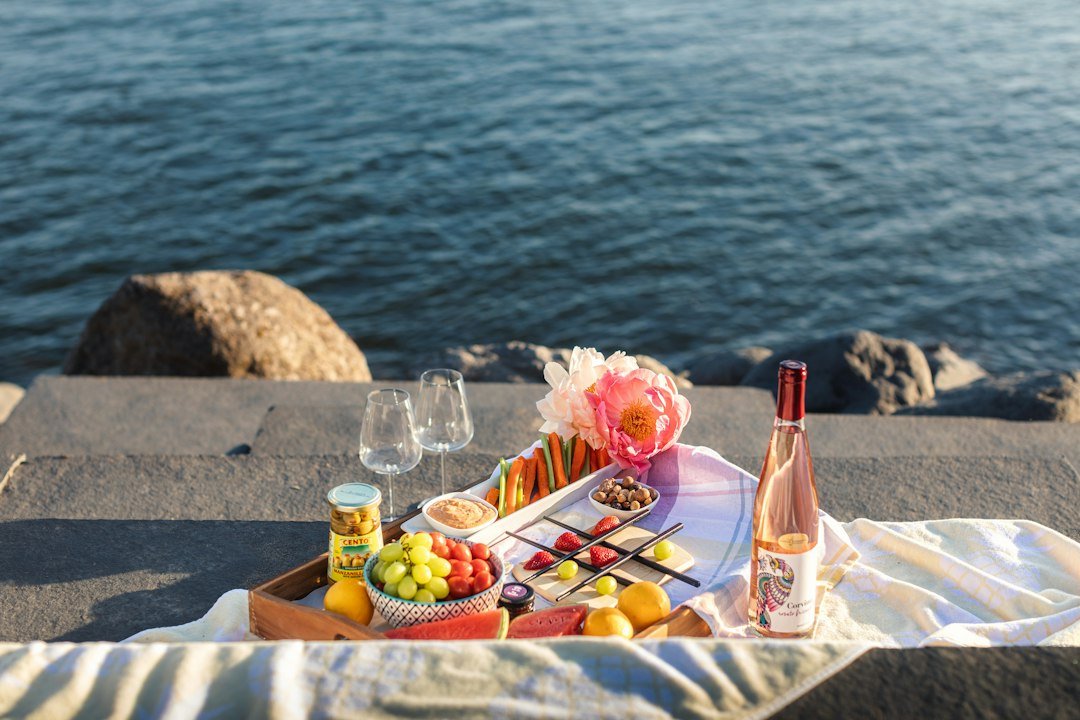
Food is where beach budgets tend to expand quietly and quickly. Resort towns price food for visitors, and eating every meal at restaurants near the water — especially when those spots have ocean views to justify their margins — adds up fast. A few approaches work consistently well regardless of destination.
If you have kitchen access, shop at a local grocery store on arrival day. Fresh fruit, good bread, local cheese, whatever looks interesting at the fish counter — a beach picnic lunch made from quality local ingredients, eaten on the sand, is often the best meal of the entire trip. It’s also the least expensive by a significant margin. Morning self-catering and packed lunches typically cost 20 to 30 percent of the equivalent restaurant spend, and the experience is often more enjoyable than sitting inside a tourist-facing dining room.
Happy hour is worth taking seriously as a meal strategy. Many beachside restaurants offer meaningfully discounted food and drinks from roughly 4 to 6pm — sometimes the same menu items at half price. A happy hour meal with a drink can cost less than lunch at the same spot during regular service hours. It’s not a compromise; it’s just timing.
Local food markets, food trucks, and small restaurants away from the beachfront consistently serve better food at better prices than tourist-facing establishments. Asking your accommodation host where locals actually eat is one of the most reliable pieces of advice you can get at any destination — and it’s free to ask.
Shop Reef-Safe Sunscreen on Amazon →
The Mindset That Holds the Whole Trip Together

Here’s what no budget spreadsheet can fully capture: the quality of a beach trip is not determined by how much it costs. It’s determined by how present you are in it. The most expensive resort in the world cannot give you that — it can only provide the setting. You bring the presence, and presence is free.
Budget beach travel has a quiet superpower. Because you’re not rationalizing the cost of a luxury add-on every time you step away from the sunlounger, you tend to spend more time doing the actual thing you came for. More water time. More sand time. More real rest. Less performance of vacation, more actual experience of it.
And on the question of how you look in your swimsuit at the beach: the ocean doesn’t care. The sand doesn’t care. The people who are genuinely enjoying themselves don’t care either, because they’re too busy being in the water to notice anyone else. Every body belongs at the beach. The only requirement is showing up. Get in — that’s where the good part is.
A beach vacation on a budget, done thoughtfully, is not a lesser version of the real thing. It is the real thing, with better stories, more intention, and a bank account that isn’t recovering for three months afterward.
Sources
- National Oceanic and Atmospheric Administration (NOAA) — coastal weather and marine conditions
- Recreation.gov — US federal beach and coastal campsite reservations
- Travel + Leisure — destination guides and travel planning