How to Choose Swimsuit Size Online: 7 Tips That Actually Work
Online retailers report return rates as high as 40% for swimwear — among the highest of any clothing category. Most of those returns aren’t about style. They’re about fit. Swimsuit sizing is genuinely inconsistent across brands: a Medium at one label can run two inches narrower in the hip than a Medium at another. Getting it right before checkout isn’t about luck. It’s about knowing which three numbers matter and how to use them.
Shopping for swimwear online starts with three measurements.
Why Online Swimwear Sizing Goes Wrong So Often
Swimwear is cut differently from regular clothing because it has to hold up under pressure — salt water, chlorine, stretched elastic, UV exposure. Brands don’t agree on how much stretch to build into their cuts. A suit labeled “true to size” from a European brand might run nearly a full size smaller than one from a US label with the same number. That’s not a flaw in the product. It’s a feature of how swimwear manufacturing works across different markets, and it’s why your usual go-to size won’t reliably save you here.
The other problem is that most swimwear reviews are close to useless for sizing decisions. “Runs small” or “fits perfectly” mean nothing without context. A woman who is 5’4” and 140 lbs experiences that same suit very differently than someone 5’9” and 155 lbs ordering the identical size. Knowing how to filter reviews — and which ones to ignore — is its own skill.
Tip 1 — Measure Your Bust, Waist, and Hips Before You Open Any Website

Take your three measurements before browsing a single product page.
Before looking at any product page, grab a soft measuring tape and take three measurements: bust (at the fullest point, parallel to the floor), waist (the narrowest part of your torso, a few inches above the belly button), and hips (the widest point across your seat). Write them down. These are the numbers you’ll use across every brand you shop — not your dress size, not your usual Small or Medium.
Measure your bust without pulling the tape tight or holding it loose — snug enough to stay in place, not tight enough to compress. For hips, stand with your feet together and wrap the tape around the widest point, usually 7–9 inches below the waist. For waist, exhale naturally and measure without holding your breath in. A half-inch error in these measurements translates directly to a half-size error in the suit.
If you’re between measurements — say your bust lands at a Small but your hips fall into a Medium — note both numbers. Tip 3 below explains which one to prioritize when you’re ordering.
Tip 2 — Throw Out Your Dress Size. Use the Brand’s Size Chart.
Every brand has its own size chart. Use theirs, not a generic one.
Every serious swimwear brand publishes a size chart specific to that label. This is the only document that matters when you’re ordering online. A size chart maps your measurements (bust, waist, hip in inches or centimeters) to the brand’s S/M/L/XL or numeric system. If a brand doesn’t publish one, treat that as a red flag — it’s a signal about how seriously they take fit.
Two things to check when reading a size chart. First, confirm the unit of measurement. European brands list in centimeters; American brands in inches. Converting is straightforward (1 inch = 2.54 cm), but missing that conversion is one of the most common and expensive mistakes in online swimwear shopping. Second, check whether the chart shows body measurements or finished garment measurements. These are different. If the chart says “waist: 28 inches,” that might mean the waist of the garment itself — your body measurement should be 1–2 inches smaller for a proper fit. Good brands specify which one they’re showing.
Tip 3 — Size for the Part of Your Body That Can’t Be Adjusted

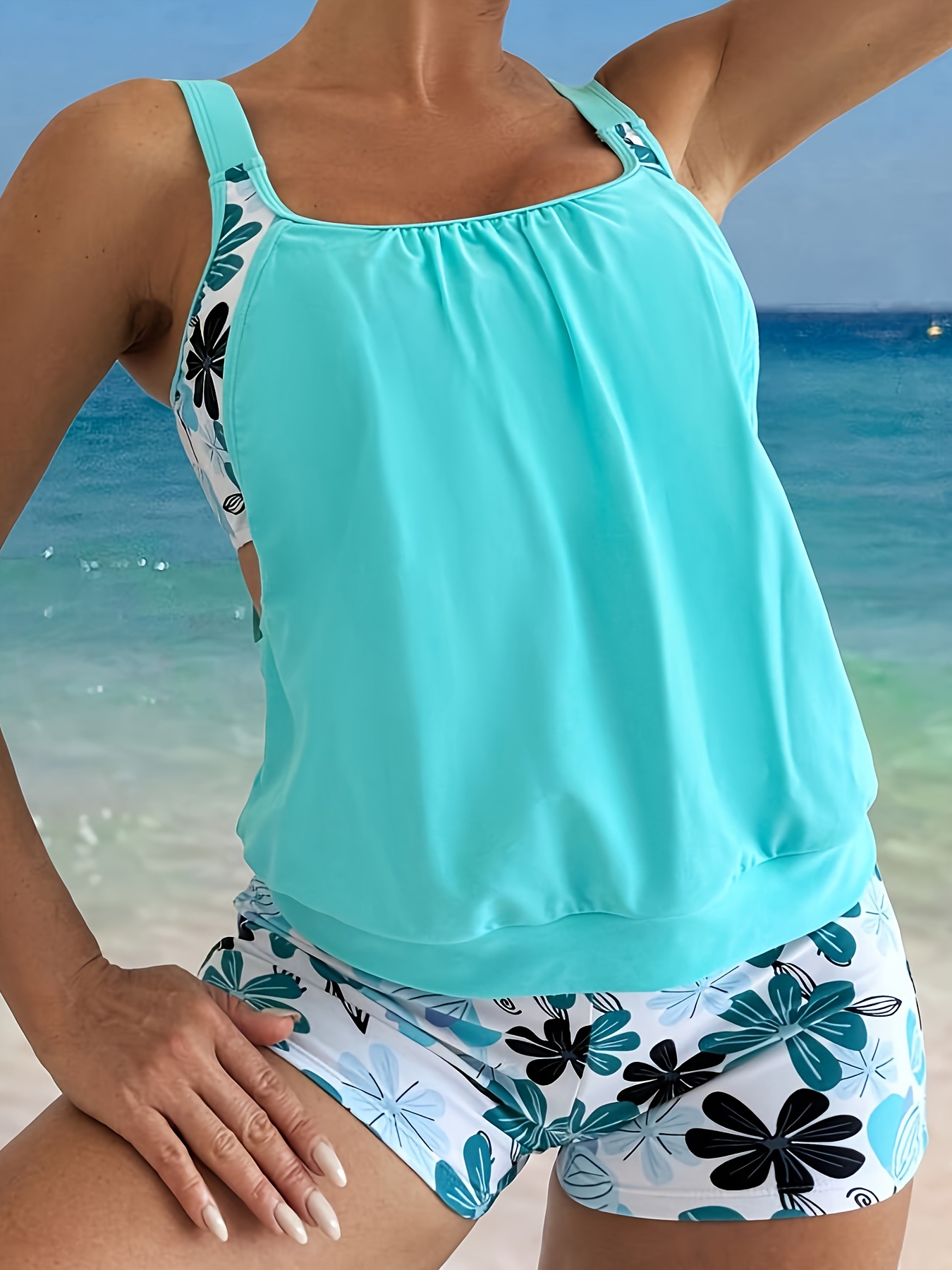
When measurements fall between sizes, prioritize whichever part of your body has the least adjustability.
When your measurements land in different size categories — a common experience for anyone whose proportions don’t match the industry’s standard charts — there’s a clear rule to follow: size for the part of your body that can’t be adjusted in the garment.
Most bikini bottoms come with tie sides or adjustable straps that accommodate a range. Triangle and bandeau tops can manage moderate differences. But structured cups, underwire built into swimsuits, and compression panels don’t give. If your bust falls into a Large but your waist reads as a Medium, order the Large. A little extra fabric at the waist can be tied tighter. An underwire that cuts into your chest can’t be fixed without altering the garment.
This is especially relevant for one-pieces and tankinis with built-in bras. In those cases, look for brands that offer mix-and-match options — separate top and bottom sizing that lets you match each piece to the right measurement independently. Many brands do this now, and it removes most of the between-size guesswork. For ideas on how to pair separates, Mix and Match Bikini: 7 Pairing Rules That Always Work covers what actually holds up.
Tip 4 — Read the Fabric Composition Before You Commit

Spandex percentage tells you how much a suit will stretch — and whether it will conform to your shape or hold rigid.
The fabric composition tells you how much the suit will stretch, and how much that stretch affects fit. Spandex (sold under names like elastane or Lycra) is the stretch fiber in most swimwear. A suit with 18–22% spandex stretches more than one with 10%, which means it will conform to your curves more closely but may feel less structured. That’s not better or worse — it depends on what you want the suit to do.
If a product listing says 80% nylon, 20% spandex, expect comfortable, supportive stretch that holds its shape across a season of regular wear. If it’s 92% polyester, 8% spandex, the suit will be less flexible — better for sporty cuts, less forgiving if you’re hoping the fabric gives you a little wiggle room on size. High-spandex suits are worth ordering in your measured size rather than sizing down, because they conform. Low-spandex suits hold their shape, so there’s less forgiveness in either direction.
For a complete breakdown of what different fabric types mean for performance, sun protection, and longevity in the water, Swimwear Fabric Explained: 7 Best Types for 2026 covers the trade-offs in detail.

Tip 5 — The Only Customer Reviews Worth Reading
Filter reviews for your height and weight, not just your size label.
Most swimsuit reviews won’t help you choose a size. “Cute bikini!” or “Love the color!” are noise. The reviews that are actually useful include three data points: height, weight, and the size ordered. When a reviewer writes “I’m 5’6”, 148 lbs, ordered a Medium, fits well in the bust but I tied the bottoms slightly tighter” — that is information you can use.
Filter by your own height range when the platform allows it. If you’re 5’3” and shopping a brand that skews toward taller frames, look specifically for reviewers near that height and pay close attention to torso length comments. One-pieces and long-line bikini tops are sensitive to torso length in ways that size charts almost never capture.
A second filter: look for reviewers with a similar fit concern to yours. Someone with a fuller bust gives you more accurate bust fit data than someone who ordered the same suit for a completely different reason. The suit behaves differently on different bodies, and reviews written with specific body context are far more useful than general enthusiasm.
Tip 6 — Know the Return Policy Before You Click Buy

A brand’s return policy signals its confidence in its own sizing.
This tip isn’t about measurements — it’s about managing the downside risk of getting a size wrong. Swimwear return policies vary more than in almost any other clothing category. Some retailers offer 30-day free returns with a prepaid label. Others charge return shipping fees that can approach the cost of the item itself. Some have hygiene exclusions that make swimwear non-returnable once the sanitary liner is removed — meaning if it doesn’t fit, you’re stuck with it.
Before ordering from a brand for the first time, check three things in the return policy: the return window (14 days vs. 30 days is a real difference), whether swimwear is covered by the policy at all, and whether you’ll receive a full refund or store credit. A brand that offers easy returns on swimwear is telegraphing confidence in its own sizing consistency. A brand that restricts returns to unworn items with tags attached and gives you 10 days is saying something else entirely.
If you’re unsure about sizing and the return policy is restrictive, ordering two sizes and returning the one that doesn’t work usually makes financial sense compared to keeping a suit that fits badly.
Tip 7 — When to Size Up vs. Size Down

Swimwear stretches slightly when wet — factor that into your choice.
The reflexive advice is “when in doubt, size up.” For swimwear specifically, that’s often the wrong move. Size up when: your largest measurement falls near the top of a size range, you’re buying a style with minimal stretch (structured one-pieces, compression surf suits), or reviews for that specific suit trend toward “runs small” across multiple body types.
Size down if: the fabric has high spandex content (18%+), the style has adjustable ties or elastic, or reviews in your measurement bracket consistently call it big. High-stretch fabrics conform — they don’t need extra room to fit well. Ordering up in a high-spandex suit just gives you more fabric, not more fit.
One thing most sizing guides skip: swimwear stretches slightly when wet. A suit that fits snugly in a fitting room will feel slightly more relaxed after 20 minutes in the ocean. That’s by design — it’s why swimwear is supposed to fit firmly on dry land. If you’re ordering for lap swimming rather than beach use, stick to your measured size or size down slightly. If it’s for a beach holiday, your measured size is the right call. For body-shape-specific guidance on which cuts work best with different proportions, Bikinis for a Rectangle Body Shape: 7 Best Styles for 2026 goes into detail on silhouette choices.

Getting swimsuit sizing right online comes down to a 10-minute prep session before you shop: measure yourself, screenshot the brand’s size chart, and cross-reference both before you add anything to your cart. That routine eliminates most of the sizing errors that end up as return shipments. The rest is knowing when a customer review is telling you something real — and that comes with practice.
Sources
- Business Insider — E-Commerce Return Rate Statistics — Industry data on return rates across clothing categories, with swimwear among the highest.
- Consumer Reports — How to Buy a Swimsuit That Fits — Body measurement guidance and practical size chart interpretation.
- Swimsuits For All — Swimsuit Size Chart — Reference size chart and measurement guide from a major inclusive swimwear retailer.