
Designer vs Budget Bikini: What You’re Really Paying For
Pick up a $28 bikini at a chain store and a $280 one from a boutique brand, and they might look nearly identical on a hanger. The real difference only reveals itself over time — after a full season of sun, salt, and chlorine. Before you decide where to put your money, it helps to understand exactly what separates them: not just the label, but the fabric technology, the construction philosophy, the fit engineering, and the math behind long-term value.
What a Designer Bikini Actually Buys You
The word designer covers a wide spectrum in swimwear. At one end are luxury fashion houses like Missoni and La Perla that extend their aesthetic into beachwear. In the middle sit heritage swimwear specialists — brands like Zimmermann, Hunza G, and L*Space — that have built loyal followings through consistent fit and quality. Below that is what the industry calls premium contemporary: labels like Solid & Striped or Frankies Bikinis that charge $100–$250 for a set but operate at a different scale than true luxury. What unites these tiers is not logo recognition — it is a systematic investment in materials sourcing, pattern development, and quality control that mass-market manufacturers cannot replicate at $30 price points.
The most significant difference starts before a single stitch is sewn: with the fabric itself. Many designer and premium swimwear brands source their materials from Italian mills in the Bergamo and Como regions, which have spent decades developing high-performance technical fabrics. These materials are typically rated to retain elasticity, colour depth, and structural integrity for 150–200 hours of chlorine exposure — a meaningful benchmark if you swim regularly. The lycra or elastane content is higher, the knit structure is tighter, and the dye process is more colour-stable under UV. Budget fabrics, sourced from lower-cost mills to hit price targets, begin showing visible fade, pilling, and stretch deformation significantly earlier, often within 30–50 hours of pool use.
Where Budget Bikinis Have Genuinely Closed the Gap
It would be inaccurate — and frankly a little reductive — to dismiss budget swimwear as simply inferior. The category has made genuine strides over the past decade that have real implications for how you shop. The first and most meaningful improvement is in sizing inclusivity. Traditionally, designer swimwear was engineered on a narrow fit model and offered sizes that topped out at a US 14 or 16. Accessible and online-first brands have rewritten that standard. Extended sizing up to 4X or 5X is now common at the $30–$70 price point, and the fit development in larger ranges has become more sophisticated: adjustable drawstring waistbands, higher-rise bottoms engineered for stretch comfort across a full size range, and tops with multiple strap adjustment points rather than fixed-length ties.
The second area of genuine improvement is trend responsiveness. Budget swimwear supply chains are tuned for speed, which means you can find this season’s exact silhouette — the micro-triangle, the asymmetric cut, the specific shade of terracotta — within weeks of it appearing on a runway or going viral. Designer brands work 12–18 months ahead of a season, which means their aesthetic can be a half-step behind the moment even when it leads on quality. For seasonal or trend-driven purchases, this agility is a real advantage.
Where budget bikinis still reliably fall short is in long-term structural performance. Cheap elastic degrades in chlorine. Thin lining becomes sheer after repeated use. Plastic hardware discolours and cracks mid-season. If you swim regularly or need structural support for a larger bust, these limitations become practical problems rather than abstract quality concerns.

Shop Affordable Bikinis on Amazon →
The Construction Details That Tell the Full Story
Fabric is only part of the equation. How a bikini is made — the density of the stitching, the quality of the hardware, the decision to line (or not) the interior panel — determines how it looks and performs on your body, not just on a flat lay or a product photo.
Lining and panel construction
A well-constructed bikini bottom uses a separate interior panel — typically in a slightly firmer, more stable knit — that adds opacity, helps the outer fabric hold its shape under tension, and creates a polished silhouette against the body. Designer and quality mid-range brands double-line as standard; the inner panel is cut to the same precision as the outer shell and stabilises it from the inside. In budget swimwear, even when lining is present, the inner fabric is often thinner and cut slightly smaller than ideal, creating tension at the seam points and failing to support the outer layer’s structure over time. The result is a suit that looks fine on the hanger but bags and shines through after a few sessions in the water.
Seams, stitching, and hardware
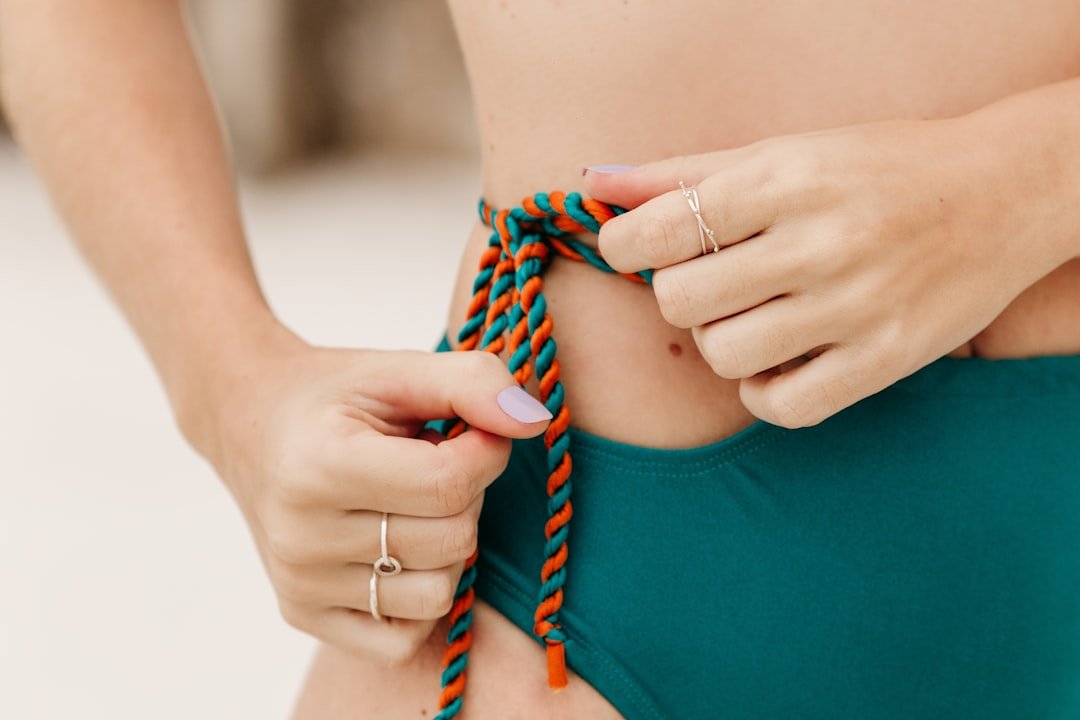
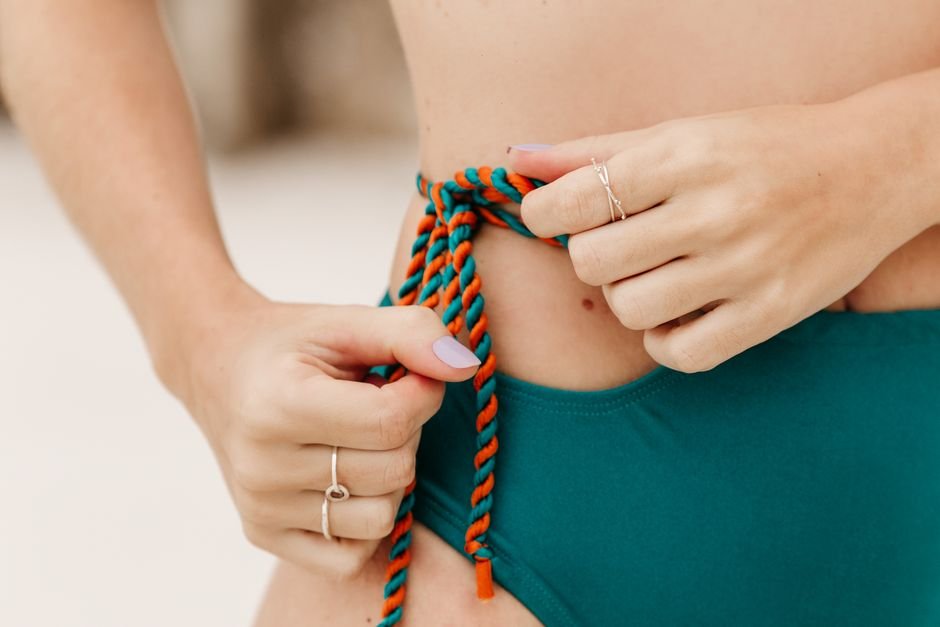
Flatlock and overlock stitching, standard in higher-quality swimwear, lies flat against the skin and distributes tension evenly across the seam — critical for preventing the fray-and-snap failure that ends many budget bikinis mid-season. Thread count and stitch density are measurably higher in quality suits. Hardware matters too: the rings and sliders on a well-made bikini are typically metal with a saltwater-resistant coating. Budget hardware is usually plastic, which discolours within a season of regular use and occasionally breaks during adjustment. For adjustable-tie tops where fine-tuning fit is a core functional requirement, this is one of the most consistently impactful quality differences in the entire designer-vs-budget conversation.
Fit, Sizing, and What Body-Positive Really Means Across Price Points
The relationship between price and fit in swimwear is more complicated than most buyers expect, because it does not run linearly in either direction. High-end designer swimwear is often developed on an aspirationally narrow fit standard, which creates real limitations for the majority of women. True luxury brands frequently offer only XS through L — a range that excludes a substantial portion of the adult female population in North America and the UK. Even premium mid-range brands that extend to XL or 2X sometimes struggle to translate their core silhouette across the size range, because pattern grading at scale requires additional development time that is often shortchanged when a brand’s primary market is a narrower size window.
Meanwhile, some of the most genuinely inclusive swimwear available today comes at accessible price points. Brands that built their customer base through online direct-to-consumer channels collected real data about what customers across the full size spectrum actually needed — higher-rise bottoms that provide coverage without compression, tops with wider-set straps for a more natural fit, adjustable ties positioned for torso length variation rather than width alone. This data-driven development has produced swimwear that fits a wider range of bodies more reliably than many designer options at twice the price.
The exception is structural support features. Underwire, power mesh panels, and boning — elements that matter most for D+ cups and above — are engineering features that require more sophisticated manufacturing and tighter quality control. Ensuring underwire sits correctly against the chest wall rather than digging in or gaping is difficult to maintain consistently at budget price points. If bust support is your primary fit requirement, this is the one area where investing in a dedicated brand — one that has built its entire identity around supportive swimwear — consistently delivers better outcomes across a season of real wear.

Shop Underwire Bikini Tops on Amazon →
Running the Cost-Per-Wear Numbers
Cost-per-wear is a useful frame for any clothing purchase, but it applies with particular force to swimwear because the degradation rate is so directly tied to use intensity rather than just calendar time. A $30 bikini worn twice a week through a four-month summer — roughly 35 sessions — will often show visible fading, pilling, and elastic stretch-out by the end of that period. The cost-per-wear across a single season looks low; the cost across three seasons, if you are replacing it annually, tells a very different story.
A $180 bikini in quality chlorine-resistant fabric, rinsed thoroughly after each use, dried flat and away from direct sun, and stored properly between seasons, can realistically last three to five summers of equivalent use. Over three years, the cost-per-wear drops below even the budget option. The catch is that this math requires genuine care. A $200 suit run through a hot wash cycle and tumble-dried will degrade at similar or worse rates than a $40 suit maintained carefully. The investment pays off for people who are willing to treat their swimwear as the functional gear it is; it does not justify itself for people whose real-world habits include machine washing on hot.
A Practical Framework for Smarter Swimwear Spending
The most useful outcome of the designer vs budget bikini comparison is not a single verdict — it is a clearer decision framework based on your actual use case rather than brand prestige or price anxiety.
Invest in quality when the performance gap is meaningful to your life. If you swim laps several times a week, need structural support for a larger bust, travel frequently to environments that stress swimwear intensively (the combination of ocean, pool, and extended sun in a single trip is particularly demanding), or have identified a silhouette that reliably works for your body and want it to last — these are the conditions where a well-made suit delivers noticeably better results over the life of the garment. The fabric holds its structure, the hardware stays functional, and the fit does not shift unpredictably after a handful of uses.
Budget is the rational choice for trend-driven purchases — suits you will wear casually a handful of times before the silhouette feels dated, colours or prints you want to experiment with without committing major spend, or extras that round out a travel wardrobe without putting pressure on any single piece. No one should feel that spending $200 is a prerequisite for feeling great at the beach. That is not what quality means in a practical context. Quality means the right product for your specific use — which is sometimes a $35 find and sometimes a thoughtful investment, and often both in the same wardrobe at the same time.

Shop Premium Women’s Bikinis on Amazon →
Sources
Resources consulted for this article:
- Vogue — swimwear trend coverage and brand profiles
- Good Housekeeping — swimwear fabric performance and durability testing
- Consumer Reports — cost-per-wear methodology and product longevity frameworks