UV Protection for Swimwear: A Beach-Day Guide to Staying Safer in the Sun
There’s a moment every summer when the sun stops feeling like a friend. Maybe it’s the tightness across your shoulders on the drive home, the surprise pink stripe where your bikini strap shifted, or the dull ache that turns to peeling skin three days later. Most of us blame sunscreen — we forgot to reapply, we didn’t put enough on, we got distracted by lunch. But the truth is that swimwear itself is doing a lot of the protective work (or failing at it), and almost no one talks about that. UV protection for swimwear is more than a label printed inside the lining. It’s the difference between coming home glowy and coming home blistered. This is a deep dive into how it actually works, what to look for, and how to put together a beach kit that lets you stay in the sun longer without paying for it later.
Why Standard Swimwear Falls Short
A regular bikini or one-piece is designed to do three things: look good, dry fast, and survive chlorine and salt. UV protection is not in that brief. Most off-the-rack swimwear sits somewhere between UPF 5 and UPF 15 when wet — which is the equivalent of leaving your skin almost completely exposed. That cheerful coral string bikini that feels safe because it’s covering you? When it’s wet and clinging, a meaningful percentage of UVA and UVB rays are still reaching your skin. The fabric is also stretched thinner across the body than it was on the hanger, opening up tiny gaps in the weave that sunlight slips right through.
This is not a reason to throw out your favorite swimsuit. It’s a reason to stop treating swimwear as if it counts as a sun barrier on its own. The coverage you can see is not always the protection you’re getting, and the gap between the two is where sunburns happen.
How UV Actually Hits You at the Water’s Edge

At a normal park or sidewalk, you’re dealing with UV coming from one direction: down. At the beach or poolside, you’re dealing with UV coming from everywhere. Water reflects up to ten percent of UV rays back toward your body, and wet sand reflects roughly fifteen to twenty-five percent depending on color and dampness. White concrete pool decks bounce even more. This means the underside of your jaw, the soft skin under your arms, the tops of your thighs, and the back of your knees are all getting hit from below as well as above.
Add altitude (UV intensifies the higher you are), latitude (tropical sun is brutal compared to temperate sun), and cloud cover (up to eighty percent of UV passes through light clouds), and you start to see why a beach day in Bali isn’t comparable to a beach day in Brighton. Your swimwear needs to do meaningfully more work in some places than in others, and it pays to know which kind of day you’re walking into.
What Real UV Protection in Swimwear Looks Like
Coverage Is the Foundation
No matter how clever the fabric, skin that isn’t covered isn’t protected by the swimsuit. This sounds obvious, but it explains why a UPF 50+ string bikini is a bit of an oxymoron — the fabric protects what it touches, and what it touches isn’t much. If sun exposure is a real concern for you, look at silhouettes first: long-sleeve rash guards, swim leggings, board shorts, high-neck one-pieces, swim dresses, and tankinis with elbow-length sleeves. Choose the cut, then choose the fabric. That order matters.
Fabric Construction Matters More Than Color
Tightly woven synthetics — particularly nylon-spandex and polyester blends — block far more UV than loose-knit natural fibers like cotton. Darker colors absorb more UV than lighter ones, but a dense, tightly woven white swim shirt will still outperform a loosely knit black one. Some swimwear is treated with UV-absorbing additives during manufacturing, and these treatments are baked into the fiber rather than washed onto it. That’s the type to look for. If the protection is sprayed on after the fact, it tends to fade within a few dozen washes.
Fit, Stretch, and the Stealth UV Killer
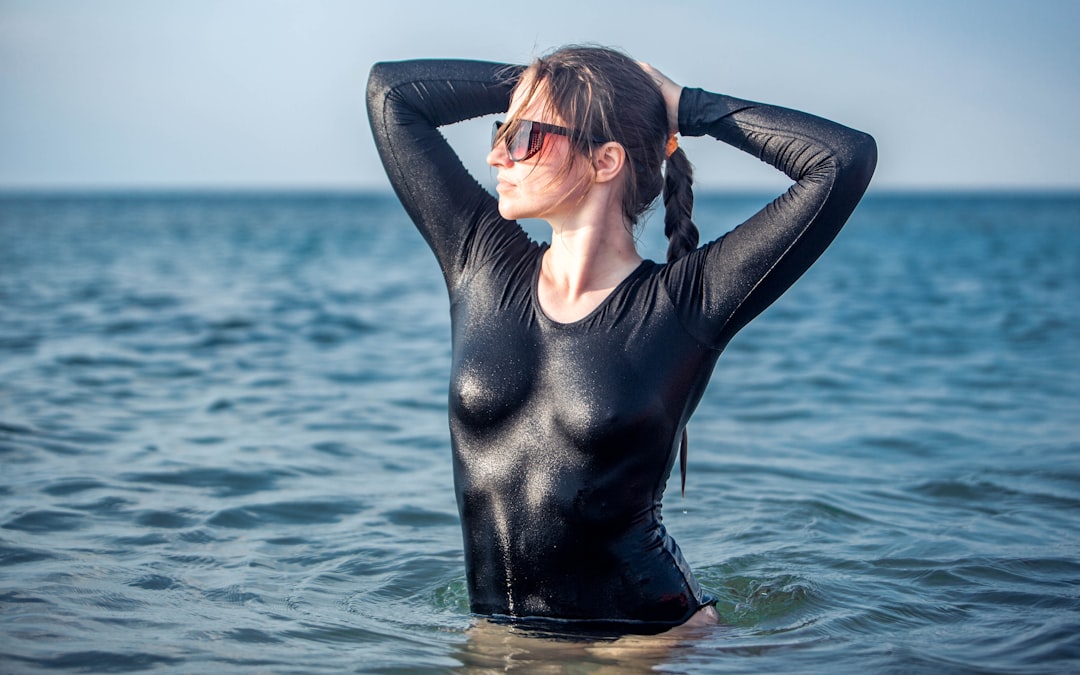
When fabric stretches, its weave opens. A swimsuit a size too small on a curvier body will let more UV through than the exact same suit fitting properly. Wet fabric also lets more light through than dry — sometimes dramatically more, depending on construction. This is why a properly fitted, dry-stays-dry style of swimwear tends to be the best performer. If you wouldn’t wear it tight, don’t buy it tight expecting it to protect you.
Building a Sun-Safer Beach Wardrobe

You don’t need to swap your entire swim drawer to get serious about UV. You need a small set of pieces that play well with each other, so on any given day you can mix the level of protection you want. Think of it as a layered system rather than a single garment.
The Long-Sleeve Swim Top
A well-cut long-sleeve UPF 50+ swim top is the workhorse of any sun-aware swim wardrobe. It throws shoulders, upper back, and the front of the chest into shade no matter the angle of the sun. Look for thumbholes if you burn on the backs of your hands easily, a stand-up neck if you have a history of neck or décolletage burns, and zip fronts if you find pullover styles claustrophobic when wet. Pair it with the bikini bottoms you already love — you don’t have to commit to a whole swim outfit just because you’re protecting the top half.
The High-Coverage Bottom

The fronts of thighs and the lower belly are common burn spots, especially when you’re lying back on a lounger and forget that those areas are facing the sun for hours. High-waisted briefs, boy shorts, and swim leggings change the geometry of how much skin gets exposure. They also tend to be flattering on a wide range of bodies — high-waisted briefs in particular hide nothing about who you are while genuinely protecting the soft skin of your lower abdomen.
The Wet/Dry Cover-Up
A proper UPF cover-up is not the gauzy crochet kaftan that lets the sun straight through. Look for densely woven cotton-poly blends, long kimono sleeves, kaftans that hit mid-thigh or lower, or swim dresses that work over your suit. The point is to throw on something between swims that breaks the cumulative exposure — the burns we tend to get are not from one minute of sun but from forty-five minutes of low-grade exposure between swims that nobody bothered to track.
Caring for UV-Protective Swimwear So It Keeps Working

UV protection isn’t permanent. Chlorine and salt water break down both the fibers and any treatments applied to them. Sunscreen residue, body oil, and friction from rolling up wet in a towel all accelerate the wear. To keep protection levels close to what they were when you bought the piece, rinse swimwear in cool fresh water immediately after every wear, hand-wash with a gentle detergent, and dry flat in the shade. Avoid the dryer — heat is one of the fastest ways to wreck the elasticity that keeps the weave tight. If your once-snug rash guard now feels saggy after eighteen months of summer, the UV blocking has dropped along with the fit. Replace it.
Sun Protection Beyond the Suit
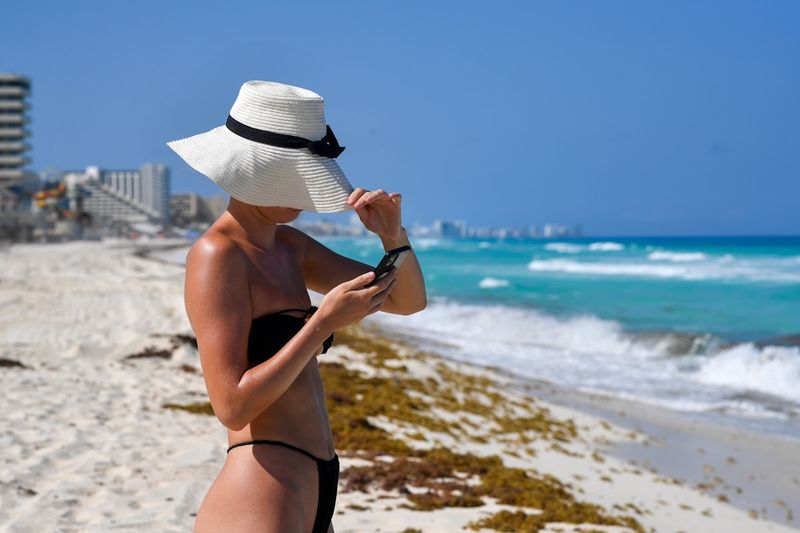
Even the best UV-protective swimwear leaves a face, neck, ears, hands, and feet uncovered. Build the rest of the system on purpose. A wide-brimmed hat with a brim of at least three inches covers more than just your face — it throws shade across shoulders and chest. Polarized sunglasses with UV400 protection guard a thin patch of skin that almost never gets sunscreen reapplied to it. Reef-safe broad-spectrum sunscreen with SPF 30+ covers everywhere the fabric isn’t, and a tinted lip balm with SPF saves you the strange line you didn’t know lips could get burned in.
Hydration matters too. Skin that is well-hydrated is more resilient under UV stress than skin that has been baking in the heat dehydrated all day. A water bottle next to your towel is sun protection wearing a different costume.
Embracing Coverage Without Hiding

There is sometimes a quiet assumption that more coverage means you’re trying to disappear — that long sleeves at the beach are a confession of insecurity. That framing is exhausting and it isn’t true. Coverage can be a flex. A jewel-toned long-sleeve one-piece with a deep scoop back, a printed swim dress that swings when you walk to the water, a pair of swim leggings with a graphic high-waisted top — these are styles people remember, not retreat into. Choosing UV-protective swimwear is choosing to enjoy the sun longer, age your skin slower, and worry less about the lounger angle you’ve ended up on.
Your body deserves to be at the beach. It also deserves to leave the beach intact. UV protection for swimwear is not about hiding — it’s about staying out there long enough to actually enjoy why you came.
Sources
- Wikipedia — Ultraviolet Index
- The Skin Cancer Foundation
- U.S. Food and Drug Administration
- World Health Organization — UV Radiation
Shop our full range of bikinis and swimwear at the BikiniCool store →